
The DEParator
Cell sorting with high-throughput dielectrophoresis
- Label-free Cell Sorting
- High throughput
- Affordable
The DEParator uses the same principles as the 3DEP to separate cell mixtures. It comprises three parts – the separator itself, a control unit, and a low-cost consumable cartridge. The separator is not more than 40 cm high, and easily fits in a biological safety cabinet – its “suspended frame” design allows it to be placed there without interrupting the airflow. The touch-driven control unit is connected by cable and can be used inside or outside the cabinet, or on a benchtop.
Throughput
We have obtained separation of over 90% purity and below 5% cell loss using the DEParator. Effective separation speeds on a single-pass strategy can exceed 300,000 cells per second. The maximum separation capacity is about a billion cells, with about 300 million in the positive DEP fraction.
Trapping Speeds
Cell Recovery
Volumetric Throughput
Trapping Capacity
FACS (N/A) – If you can wait for it to catch up at 6700/s


GMP-compliance
The independence from surface markers and magnetic or fluorescent antibodies makes DEP the ideal cell-sorting approach where cellular purity cannot be compromised. No expensive fluorophores or magnetic beads means nothing is left behind in the cells after processing. The only cell preparation is resuspension in an iso-osmotic sugar-salt solution to optimise the separation (which can be tailored for your cells).
Using disposable cartridges, separation by DEParator can be GMP-compliant for your therapeutic applications.
Flexible Operation
The system can be operated in any number of procedures depending on your requirements, you have total control over experimental volumes, flow speeds and signal strengths. Using the accompanying control box it is easy to setup and save experimental procedures to allow for aliquoting or swapping of input/output containers during operation.
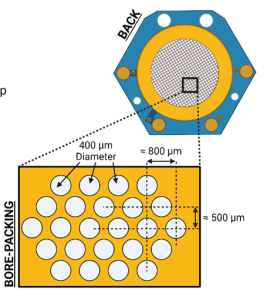
The consumable contains one of our DEP-Well chips, designed with over five hundred separating wells. The solution to be separated (up to 15mL) is drawn through the chip, allowing a first separation pass, then expelled giving a second separation pass and returning only one cell type to the cell tube. Fresh medium is then added, the field deactivated and the positive DEP fraction released for collection.
Label-free separation
Unlike FACS or MACS, DEP is not reliant on the addition of selective labels which are expensive, require removal and can reduce viability among biological samples. Dielectrophoresis is instead dependant on the polarizability relationship between a particle and its surrounding medium. For biological cells, this particle polarizability is a function of the cell’s electrophysiology and depends on factors such as morphology, surface chemistry, subcellular organelles, and ionic contents.